GPS Dog Fence Collars: Halo vs SpotOn vs Fi (and When a Wireless Fence Makes Sense)
Heads up: this post contains affiliate links. If you buy through them we may earn a commission, at no extra cost to you. Learn more.
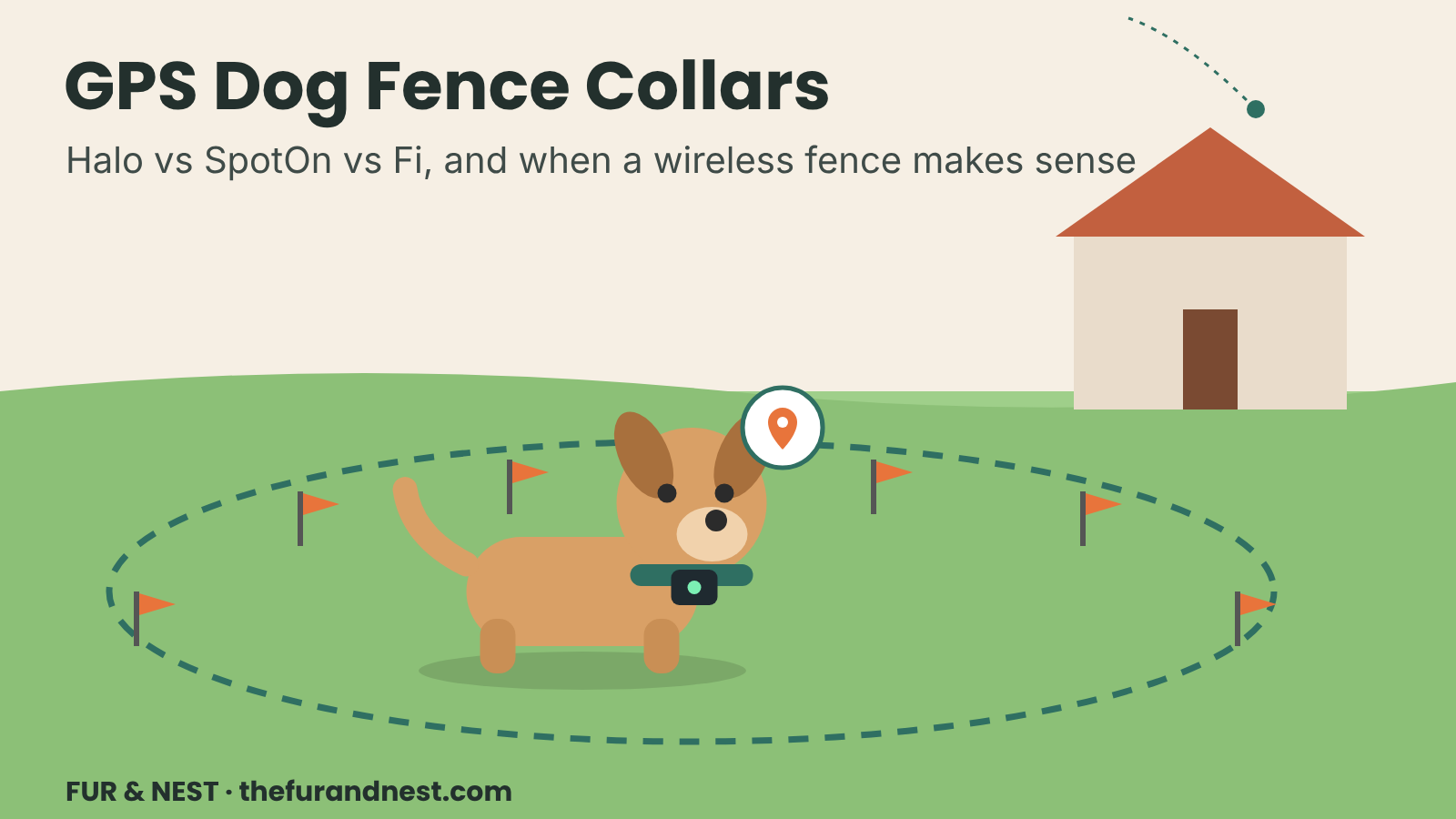
A GPS dog fence collar promises something every owner of a big yard wants: a boundary without digging, posts or buried wire. You draw the fence on your phone, the collar cues your dog near the edge, and you get an alert if they leave. For rural homes, HOAs that don't allow fences, and properties too big to fence, that is a real option.
It is also a category where products that look alike work very differently. Some are true containment systems, some are trackers that only tell you your dog left, and some need a monthly plan before they do anything. Below, each pick says who it suits and when to skip it. If your dog spends time home alone, our home-alone pet gadget guide and dog camera guide cover the indoor side.
GPS fences and trackers worth a look
1Halo Collar 5: the best-known GPS fence collar
Halo is the GPS fence most people hear about first, and the Collar 5 is its current model. You draw boundaries in the app, the collar gives your dog cues as they get close to the edge, and you get a phone alert if they cross it. The listing says it combines dual-frequency GPS with ground-station corrections for accuracy, and includes a built-in training program.
Two things to know before buying: a Halo membership is required to turn on GPS tracking and the fence, and owner reviews are mixed (accuracy near houses and trees comes up often). Read recent reviews for homes like yours.
Best for: larger yards or rural properties where a physical fence isn't practical, and owners willing to spend a few weeks on training.
Skip it if: you don't want a monthly plan, or your yard is small and tightly surrounded by buildings.
2Nova GPS dog fence collar (SpotOn): no base station, works without a plan
This app-controlled GPS fence collar lets you draw unlimited fences of any shape, add keep-out zones (pool, garden, driveway) and correction-free areas. It focuses on keeping the boundary steady in tree cover and low-signal spots, which is exactly where many GPS fences struggle.
Compared with Halo, the main draw of SpotOn-style collars is that the fence itself works out of the box, with a subscription only needed for live tracking extras. Check the listing's neck-size range before ordering.
Best for: wooded or irregular properties and owners who want to avoid a required monthly plan.
Skip it if: you have a small lot. GPS fences need room to work well.
3Omni GPS dog fence collar: built for bigger properties
The Omni collar uses the same True Location GPS approach and lets you create fences from half an acre up to very large properties, with no buried wire or base station. The listing says fences work without a subscription, and the rechargeable battery runs 40+ hours if you skip the tracking plan.
It is sold by neck size (the medium version fits roughly 12-18 inch necks), so measure first.
Best for: farms, acreage and big open yards.
Skip it if: your property is under half an acre, which is below the listed minimum.
4Fi Series 3+: a smart tracker collar, not a fence
Fi is a GPS tracking collar rather than a containment system. It doesn't cue or correct your dog at a boundary. Instead it tells you fast when your dog leaves a safe zone and shows where they are on a map using GPS and cellular coverage. Many owners use it alongside a physical fence as an escape alarm.
A Fi membership is required at activation, so factor that in.
Best for: dogs that occasionally slip out the gate or dig under a fence, and owners who mainly want to find them quickly.
Skip it if: you need something that keeps your dog in the yard on its own.
5Tractive GPS tracker: the budget-friendly escape alert
Tractive clips onto the collar your dog already wears. You set virtual fences around your yard or neighborhood and get an alert with live location if your dog leaves. The listing says it is waterproof, light enough for dogs over 8 pounds and lasts up to 14 days per charge.
Like Fi, it needs a subscription and doesn't contain your dog; it helps you find them.
Best for: a low-cost first step, travel, hikes and dogs with a history of bolting.
Skip it if: you want boundary training or no ongoing plan.
6PetSafe Stay & Play Compact: the no-dig wireless fence (not GPS)
This is the long-running alternative to GPS: an indoor base station creates a circular boundary up to three-quarters of an acre (22-105 feet in every direction), and the collar responds when your dog reaches the edge. It needs no satellites, phone app or monthly plan, and it is portable to a vacation home with an outlet. The listing says dogs can come back into the play area without a correction.
The boundary is a circle around the base station, so it doesn't follow an irregular property line, and it uses static correction levels, so many owners start with the lowest setting and work with a trainer.
Best for: roughly square yards, renters who can't install fencing, and owners who don't want a subscription.
Skip it if: your yard is long and narrow or you prefer a correction-free approach.
What to look for in a GPS dog fence
- Fence or tracker. Halo, Nova and Omni give boundary cues. Fi and Tractive only alert you and show location. Decide which problem you are solving.
- Membership. Check whether the fence works without a plan, and what stops working if you cancel one.
- Yard size and shape. GPS needs space and open sky; trees and nearby buildings reduce accuracy. Circular wireless fences suit square yards, not long narrow ones.
- Cue options. Look for tone and vibration settings and how strong any static correction is. Many owners start with the gentlest settings.
- Fit and weight. Measure your dog's neck and check the minimum dog weight. A heavy collar can be too much for small dogs.
- Battery. Daily charging is normal for GPS fence collars. Plan a routine so your dog never goes out with a dead collar.
Training tips before you rely on it
- Walk the boundary with your dog on a leash for the first days, letting them hear the warning tone near the edge.
- Use flags or markers at first so your dog can see the line, then remove them gradually.
- Keep early sessions short and reward your dog for turning back.
- Don't leave your dog unsupervised with a new system until they reliably respect the boundary.
- Keep a regular collar and ID tag on your dog too, in case the smart collar is off or out of battery.
Frequently asked questions
Does a GPS dog fence need a subscription?
It depends on the brand. Halo requires a membership to turn on GPS and the fence. The SpotOn-style Nova and Omni collars say the fence works without a subscription, with a plan only for live tracking extras. Fi and Tractive are trackers and require a plan. The PetSafe Stay & Play doesn't use GPS and has no plan.
What is the difference between a GPS dog fence and a GPS tracker?
A GPS fence gives your dog cues at a boundary to keep them in the yard. A GPS tracker, like Fi or Tractive, doesn't stop your dog; it alerts you when they leave and shows where they are. Some owners use both: a physical or GPS fence plus a tracker as a backup.
How big does a yard need to be for a GPS dog fence?
GPS accuracy is measured in feet, so these systems work best on larger lots. Omni lists a half-acre minimum. On small city lots, a physical fence, the PetSafe circular fence or a tracker is usually more practical.
Is a wireless dog fence a substitute for a real fence?
Not entirely. Wireless and GPS fences don't keep other animals or people out, and a very motivated dog can still run through a boundary. They take consistent training, and many owners work with a trainer. If you are unsure whether one suits your dog, ask your vet or a certified trainer.
We don't accept payment for placement. Prices and availability change often, so check the retailer for current details. As an Amazon Associate we earn from qualifying purchases.